How to organise a coffee break for 20, 50 or 100 people
A good coffee break goes unnoticed: nobody queues, the coffee does not run out halfway through the break, and the room fills up again at the planned time. This guide shows how to organise a coffee break: what to decide before the meeting, with quantities per person for 20, 50 and 100 guests, so nothing is left to improvisation.
What a coffee break is and what it is for
A coffee break is a short pause, of about 20 to 30 minutes, within a working day, a training session or a conference. Hot and cold drinks are served with small pieces eaten standing up and without cutlery. It helps people regain their focus and gives them a chance to talk between sessions.
If you only want the definition, it is in the glossary (coffee break and welcome coffee); here we get practical.
It is not a lunch or a full breakfast: it is a scheduled break. That difference shapes everything else, from the quantities to the set-up. If what you need is a one-hour working breakfast, the calculation changes, as you will see below.
If you are looking for someone to prepare it and deliver it to your office, see the office breakfasts and coffee breaks from María Lluch Catering. Here we explain how to organise it, whoever you hire.
What to include in a coffee break
A basic coffee break has a hot drink, water, one or two savoury pieces, something sweet and fruit. The hot drink is the star: it is what is consumed most and what is missed most when it runs out. The rest is spread out so that everyone finds something they fancy.
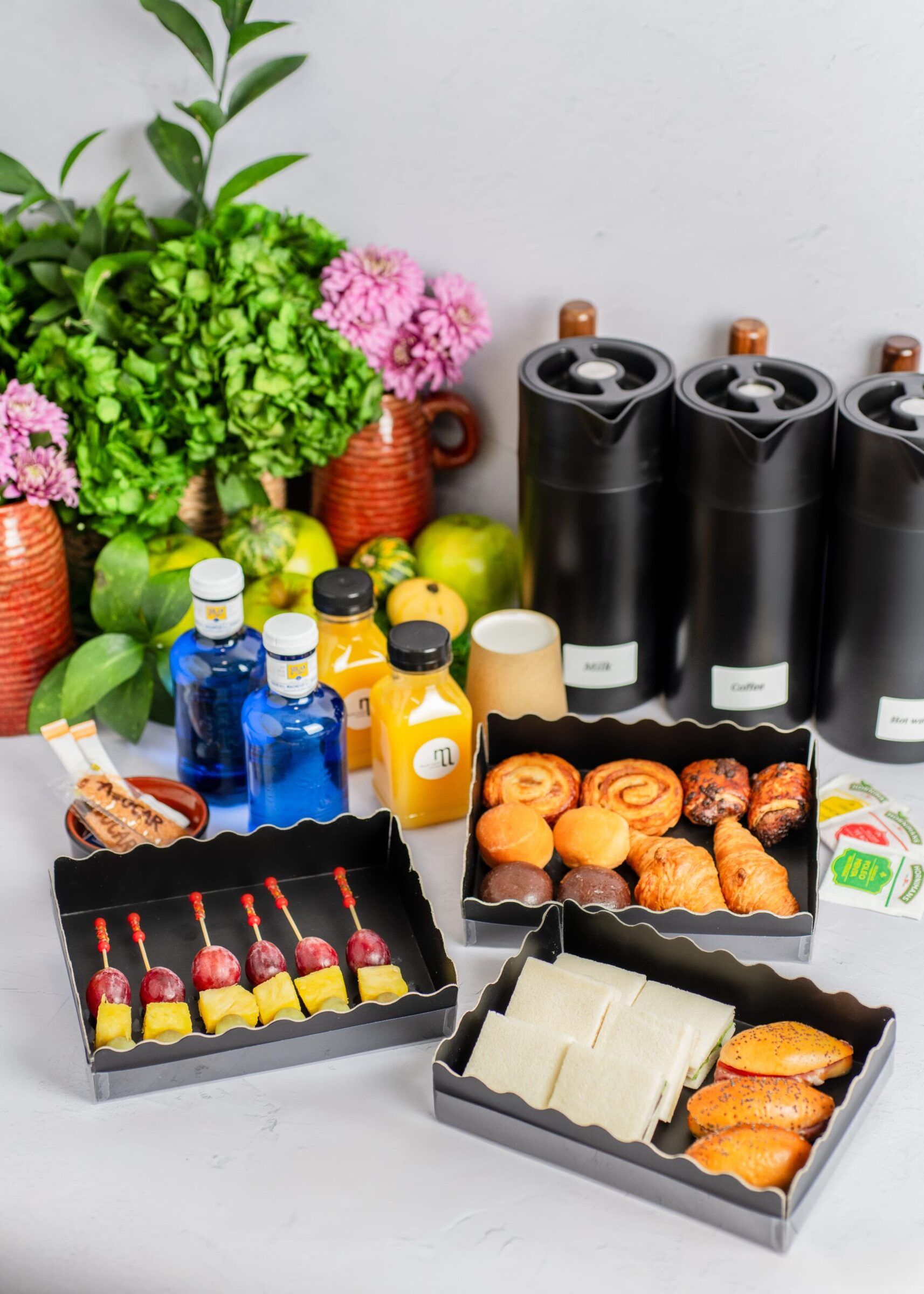
A balanced selection that is easy to eat standing up:
- Hot drinks: coffee, decaffeinated coffee, milk and tea or herbal teas. Decaf and herbal teas are often forgotten and are the first thing someone asks about.
- Cold drinks: always water; juice if it is first thing in the morning.
- Savoury pieces: mini sandwiches, mini baguettes or filled croissants. They should be easy to pick up with one hand.
- Sweet pieces: mini pastries, sponge cake or biscuits.
- Fruit: cut up or on skewers, so nobody has to peel anything with a cup in their hand.
What matters is not variety for its own sake, but that each item can be eaten in two bites without making a mess. With two or three different savoury pieces, two sweet ones and a fruit, the table already looks complete.
How much food and drink to order per person
As an industry rule of thumb, for a coffee break you allow per person: 1.5 cups of hot drink, 330 ml of water, 1 savoury piece, 2 sweet pieces and 60 g of fruit. That is 3 pieces in total. Multiply by the number of guests and add a margin for the unexpected.
The table applies those quantities to 20, 50 and 100 people. They are guideline figures, the same as in the calculator in our catering price guide, and they are not a firm proposal: they are adjusted for the time of day and the profile of your guests.
| Item (per person) | 20 people | 50 people | 100 people |
|---|---|---|---|
| Hot drink (1.5 cups) | 30 cups | 75 cups | 150 cups |
| Water (330 ml) | 6.6 litres | 16.5 litres | 33 litres |
| Savoury pieces (1) | 20 | 50 | 100 |
| Sweet pieces (2) | 40 | 100 | 200 |
| Fruit (60 g) | 1.2 kg | 3 kg | 6 kg |
| Total pieces | 60 | 150 | 300 |
On top of these figures, add a 5% margin for the unexpected and for people who go back for more. For events of 100 people or more, the industry usually extends this to 10%.

If it is really a working breakfast
If the meeting is first thing in the morning and lasts an hour, people tend to arrive without having had breakfast and the break is no longer a simple rest. In that case, the same rule of thumb rises to 2 savoury pieces, 2 sweet pieces, 150 ml of juice and 100 g of fruit per person. For 50 people that is around 200 pieces instead of 150.
Recommended timings and duration
The usual approach is to schedule the coffee break mid-morning or mid-afternoon, lasting 20 to 30 minutes. Any shorter and you get queues and people who miss out; any longer and the room is slow to fill up again, so the next session starts late.
A few rules that work:
- Put it in the agenda, not at random. A break fixed in advance is respected; an improvised one drags on.
- Match the length to the group. With 20 people, 20 minutes is enough. With 100, allow closer to 30, because serving yourself takes longer.
- If it is first thing in the morning, consider a working breakfast or a welcome coffee on arrival, with more fruit and savoury items.
- Ask for it to be ready early. The service should already be set up when the session ends, not just starting to go out.
Setting up in the room: where and how to arrange it
Set up the coffee break outside the meeting room, but close by, with space to move around. Spread the drinks and food over different points to avoid queues, and arrange the pieces from lightest to heartiest. The easier it is to serve yourself, the sooner people will be back in their seats.
What helps most in practice:
- Several serving points from 50 people upwards. A single table for 100 guests guarantees a queue.
- Coffee and water separate from the food, so that someone who only wants a coffee does not wait behind someone helping themselves to several pieces.
- Height and reach. Trays at a height that lets people pick them up without bending down; everything within reach of one hand.
- Napkins, cups and a bin in view, close to where people leave their used items.
- Signs with the ingredients of each piece, so everyone knows what they are choosing.
- Delivery access. Tell whoever is bringing it where to unload, which floor it is on and whether there is a lift.
Healthy and vegetarian options, and allergens
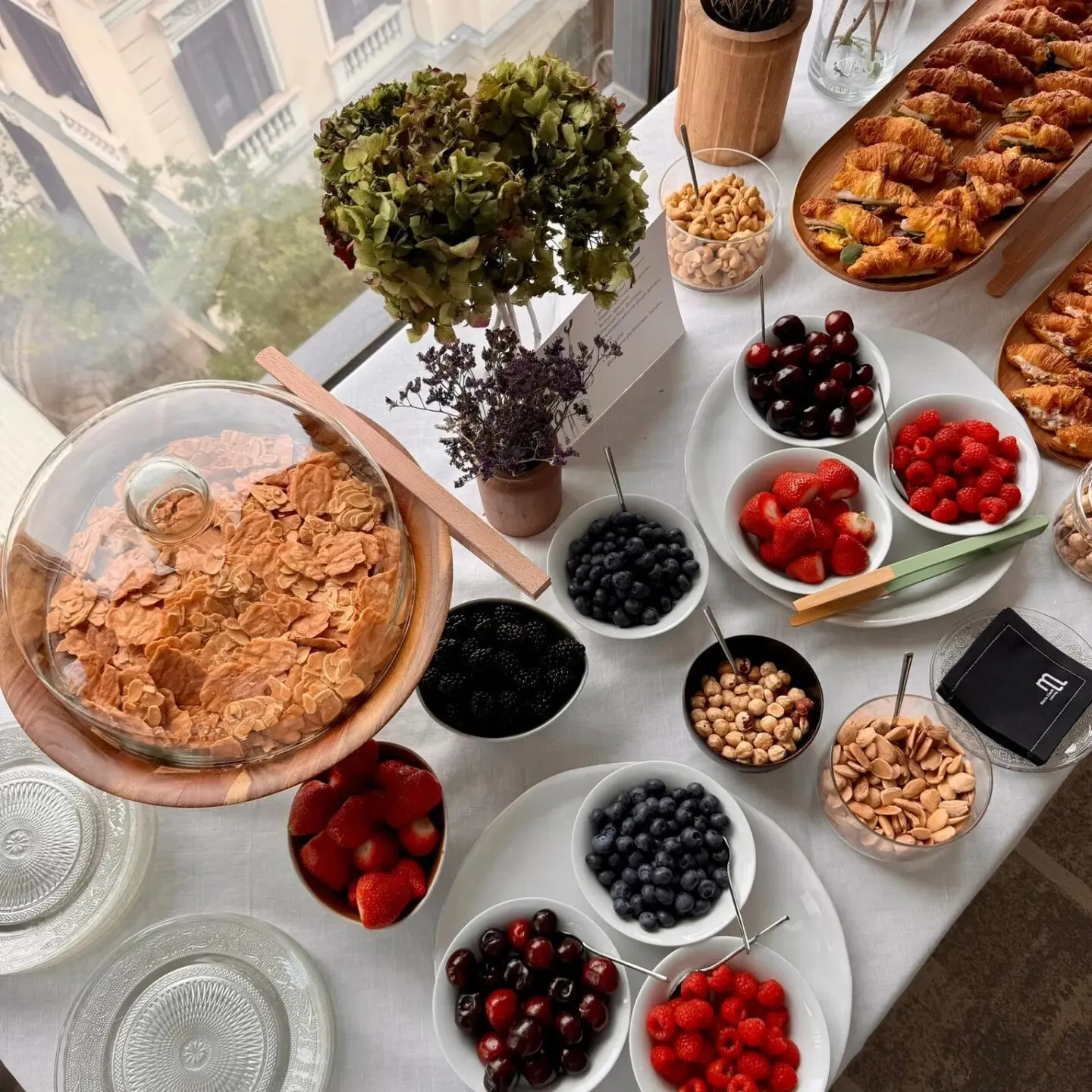
Always include something light and at least one vegetarian option, and ask guests about allergies and intolerances when you send out the meeting invitation. Regulation (EU) No 1169/2011 requires information on the 14 allergens even for unpackaged food, so you can ask the supplier what each piece contains.
So that there are no surprises:
- Ask when you send the invitation. One line in the invitation (“Any allergies or intolerances?”) avoids problems on the day.
- Fruit and nuts are easy to include, but tree nuts and peanuts are among the 14 allergens: they should be labelled and kept apart from the rest.
- Gluten-free, lactose-free or vegan options: if guests need them, order them in advance and make sure they are clearly identified, not mixed in with the rest.
- Drinks. Water, herbal teas and a sugar-free option for anyone who does not want juice.
- Get it in writing. Ask the supplier for the allergen list for each piece and share it with the guests who need it.
Common mistakes when organising a coffee break
The most common mistakes are running short of coffee, miscounting the number of guests, not planning for special diets and setting up the service inside the room. All of them can be avoided with a checklist and by confirming actual attendance a few days before the event.
- Ordering for everyone invited rather than everyone attending. Confirm how many will really come and adjust a few days before.
- Serving only sweet things. Mid-morning, many people prefer something savoury.
- Forgetting decaf, herbal teas and lactose-free milk.
- One table for everyone. It creates queues and drags out the break.
- Setting up in the meeting room itself. It interrupts the session and leaves a smell of food during the next one.
- Not warning about the logistics. Floors, access, delivery times and who collects afterwards.
- Cutting quantities too fine. A small margin is better than leaving nothing for the last person to be served.
Checklist: how to organise a coffee break, stage by stage
A coffee break is prepared in four stages: one or two weeks before (date, guests, dietary needs, venue and quote), a few days before (actual headcount, allergens and access), on the day itself (set-up and tableware) and afterwards (collection and review). Copy this list into your event plan and tick items off as you go:
One or two weeks before
- Date, start time and length of the break (20 to 30 minutes).
- Estimated number of guests and format (coffee break or working breakfast).
- Ask about allergies, intolerances and diets.
- Decide where it will be set up and how to get to the area.
- Request a quote and confirm what it includes: staff, tableware, set-up and collection.
A few days before
- Confirm the actual number of guests and adjust the quantities.
- Check the allergen list for each piece.
- Tell the supplier about delivery access and confirm what time the service arrives.
On the day of the event
- Service set up before the session ends.
- Coffee and water separate from the food; ingredient signs in place.
- Cups, napkins and bins to hand.
- Someone from the organising team to meet the supplier.
Afterwards
- Collection of the service and of any leftovers.
- Note how much was left over or ran short, to adjust next time.
Frequently asked questions about the coffee break
How long should a coffee break last?
It is a short pause of 20 to 30 minutes in the middle of a working day, with coffee, other drinks and small pieces, savoury and sweet, eaten standing up. It is usually set up in a space next to the meeting room, so that people can help themselves, chat for a while and go back to the session.
What can you serve at a coffee break?
The usual choice is coffee, herbal teas, water and juice; mini sandwiches or baguettes, filled croissants, mini pastries, sponge cake and cut fruit. It is worth including a vegetarian option and an alternative for special diets. If it is first thing in the morning, add more savoury items and fruit, because the break works as a breakfast.
How much coffee do you need for 50 people?
As a rule of thumb, 1.5 cups per person: about 75 cups for 50 guests, plus a 5% margin for the unexpected. In practice, some people go back for more and others do not drink coffee, so you should also have decaf, herbal teas and enough water.
How many staff are needed to serve a coffee break?
Many coffee breaks run as self-service: the supplier leaves the table set up and someone from the organising team makes sure the coffee and water do not run out. If there are staff, their job is to top up drinks and pieces and clear away what has been used. With 50 people or more, it is worth having someone focused solely on topping up and several serving points; the exact number is set by each supplier according to the space.
Next step
With the number of guests, the time and the venue, you can now request a proposal. If you want an idea of the cost, start with the guide to prices and quantities. And if you would like us to take care of it, tell us the date and number of guests and we will prepare a proposal for an office breakfast or coffee break for your company.
Related service: Breakfasts and coffee breaks
More in Blog.