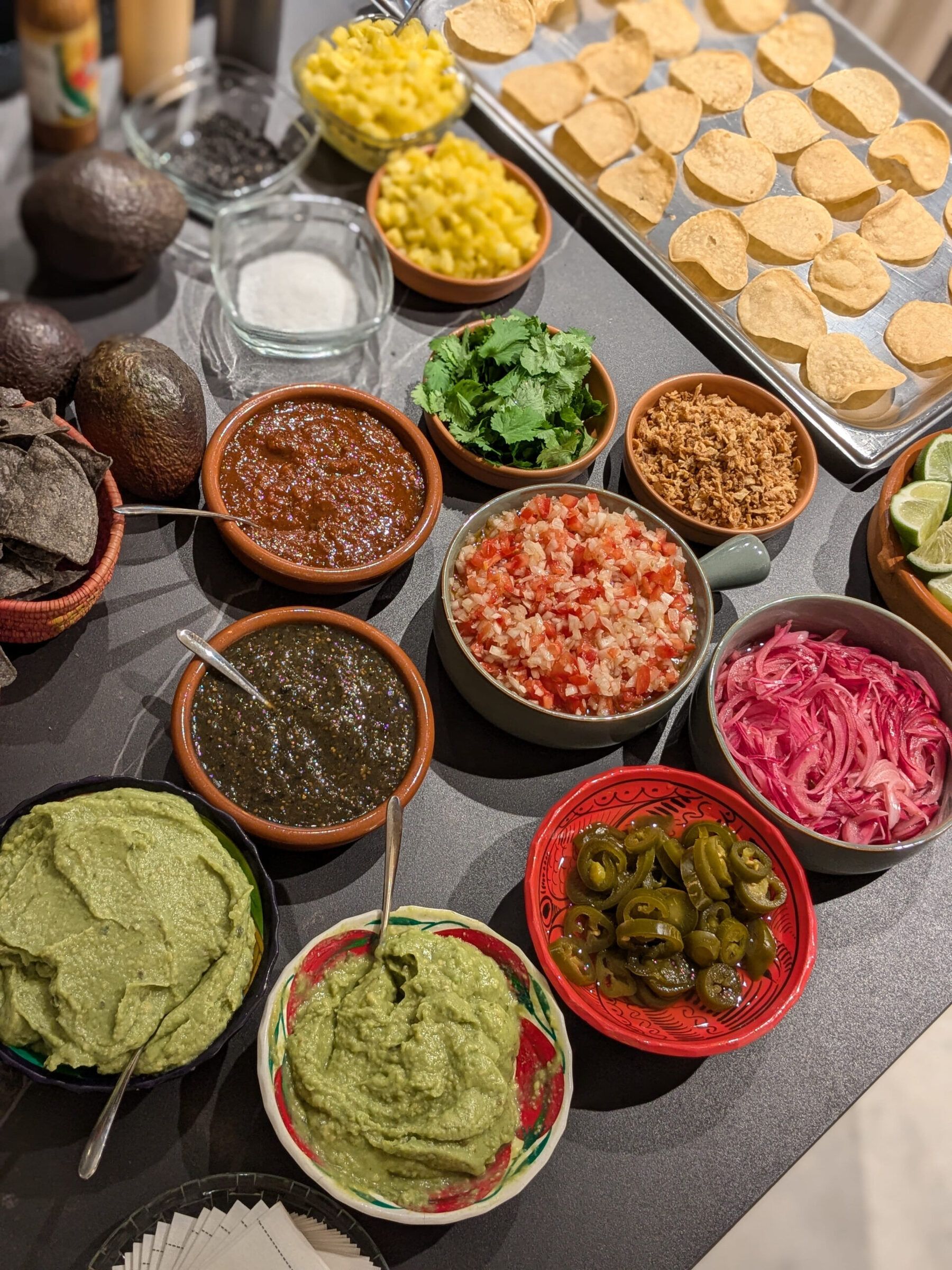
How to organise a live cooking event
More and more companies want the food at an event to be more than a formality between one meeting and the next. Live cooking answers that: the kitchen steps out from behind a door and sets up in the middle of the room. This guide explains how to organise a live cooking event: what it is, which types exist, when it is worth it and what to have ready before you book it.
How live cooking works at an event
Live cooking (usually called showcooking in Spain) is a way of serving the food at an event in which the cook prepares or finishes the dishes in the room itself, in full view of the guests, and serves them as soon as they are ready. The cooking no longer happens in a hidden kitchen; it becomes something the group watches, comments on and tastes.
The Spanish term is borrowed from the English “show cooking” and is written as one word or two; Spanish speakers also say cocina en directo or cocina en vivo (cooking live). The short definition is in our glossary entry on live cooking; here we focus on how it works and when it is worth choosing.
You can recognise it by three things:
- The cooking is in view. Ingredients, technique and plating happen in front of the audience.
- Nothing waits. The dish goes from the griddle or the board to the guest’s hand, with no trays or chafing dishes in between.
- The station sparks conversation. People ask the cook questions, chat with whoever is next to them and come back for seconds.
Types of live cooking
There are four common ways to set it up, and they can be combined: product-led, chef-led, live station, and participatory versus demonstration. Which one you pick depends on the number of guests, the space and whether you are after a show, a full meal or a standing atmosphere.
- Product-led. The star is one ingredient or dish: a ceviche, tacos, fresh pasta. The cook finishes it in front of everyone and serves it.
- Chef-led. The focus is on the person cooking, who explains what they are doing and why at each step. It works well when you want a moment of shared attention.
- Live station. One or more stations are set up around the room and each serves its own speciality. It is the most convenient format for drinks receptions and standing events. You will find the detail in our entry on the live station.
- Participatory or demonstration. In a demonstration, guests watch and taste. In a participatory session, the group joins in and cooks something with the chef’s guidance. Be careful with the second: it needs more time, more space and more equipment per person.
Which events it suits
Live cooking suits events where the food can take centre stage and the group is happy to move around and talk: corporate events, team building, product launches and private celebrations. It works less well when the programme is very tight or the room leaves no space for people to get up.
- Company events. Quarter-end celebrations, client meetings or team days when you want something different from the usual drinks reception.
- Team building. The station acts as a meeting point and gives a common topic to people who rarely cross paths. If what you want is for the team to actually cook, that is closer to a workshop (we cover it below).
- Launches and presentations. It gives people a reason to stay and mingle after the presentation, and makes it easier to talk to attendees.
- Celebrations. Birthdays, anniversaries or special dinners where the food is part of the surprise.
If you are thinking of bringing it to your company, María Lluch’s live cooking in Madrid explains how we approach it and which cuisines we work with.
What you need to organise a live cooking event
To organise live cooking you need six things: space for the station, a solution for fumes and smells, enough electricity, a water point, permission from the venue and the group’s list of allergies and dietary needs. The specific figures (metres, power, setup times) depend on the menu and the supplier, so it is best to ask for them early.
- Space. The station should be in view with room around it so people can come up without queues forming. Also think about access for bringing in the equipment.
- Fumes and smells. If you cook with heat, check the room’s ventilation, especially in an office or a closed room: fumes are a nuisance and can even set off the fire alarm. Ask the building what precautions it requires. Cold menus, such as a ceviche, produce hardly any fumes.
- Electricity. When the venue does not allow a flame, cooking is usually done on electric or induction hobs, which can need a lot of power. Ask your supplier what equipment they bring and check with the venue which sockets are available and how much load they can take.
- Water. For cleaning and preparation. Knowing where the nearest water point is avoids surprises on the day of the event.
- Venue rules. Every building or venue has its own rules, and it is common for them to restrict gas or open flames indoors for fire safety. Also ask about the insurance they require from suppliers, setup times and loading access, and get in writing what they authorise.
- Allergies and dietary needs. Tell us about allergies, intolerances and diets when you ask for the proposal. Regulation (EU) No 1169/2011 requires information on the 14 allergens even for unpackaged food, and at a live station it is worth asking how cross-contamination between dishes is avoided.
How it differs from classic catering and from a cooking class
Live cooking differs from classic catering in that the dish is finished in front of the guest, and from a cooking class in that the aim is the experience of the event, not learning a recipe. Neither catering nor a class is worse: they serve different purposes.
| Classic catering | Live cooking | Cooking class | |
|---|---|---|---|
| Where it is prepared | In a kitchen, out of sight | In view of the guests | In a kitchen or classroom with workstations |
| How the dish arrives | Already prepared, plated or on a tray | Finished and served on the spot | Prepared by each participant |
| The guest’s role | Eats | Watches, chats and tastes | Cooks and learns |
| Aim | Feed people comfortably | Create a moment of experience | Learn a recipe |
| Space needs | Serving table | Chef’s station, supplies and ventilation | Workstations for each person |
| Pace of the event | Set by the format (drinks reception, buffet or seated meal) | The group moves around the station | Set by the class |
You do not have to choose between classic catering and live cooking: they can be mixed. A drinks reception with finger food and one or two live stations adds variety without complicating the setup. To see what the classic format looks like, take a look at our corporate catering in Madrid.
An example: tacos, ceviches and aguachiles made on the spot
Mexican and Peruvian cuisine are two good examples of live cooking because many of their dishes are finished in a short time and eaten straight away: tacos, ceviches, aguachiles. At María Lluch Catering they are our speciality, and we prepare them with quality ingredients, true to the traditional recipe, with an innovative twist.
They shine live because they are colourful, assembled in view and encourage people to come up to the station. We also work in other styles: Mediterranean, Asian and Italian cuisine, and a vegetarian option. If the format interests you, see how we do it in our Mexican and Peruvian live cooking.
Frequently asked questions
Which dishes work best at a live cooking event?
Those that are finished in a short time and eaten freshly made: tacos, ceviches, fresh pasta, woks or sushi. Long stews or roasts that take hours fit less well, because the guest does not see the process and the station stands idle. Nor does everything need a flame: a ceviche is prepared cold.
What is the difference between live cooking and a live station?
It is a question of scale. A live station is a single stand serving one speciality, for example tacos or pasta, and it can sit within a drinks reception or a buffet. Live cooking is the wider approach: building the event around cooking in front of the guests, with one or several stations in the same room.
Can you do live cooking in an office without a kitchen?
In many cases, yes: the supplier brings their own equipment and sets up the station in a room or common area. What you need to check is the space, the electrical power, a nearby water point and whether the building allows cooking with heat. If it does not, a cold menu is a good alternative.
Is live cooking the same as a cooking class?
No. In live cooking the chef cooks and the guests enjoy the experience and the freshly made food; in a class, each participant cooks and learns the recipe. Some participatory formats come close to a class, but the aim is still the event.
Next step
If you are thinking of live cooking for your team or for a celebration, start with live cooking in Madrid to see how we do it. When you have a date, number of guests and space, tell us about your event and we will prepare the proposal. To understand the terms better, see our entries on live cooking and the live station.
Related service: Live cooking
More in Blog.