What to serve at a business meeting or training day, by duration
What to serve at a business meeting depends less on the menu than on the clock: how long it lasts, what time it falls and how much work is left afterwards. A coffee is enough for a one-hour meeting, but a training day needs breaks and a lunch that does not leave anyone drowsy. This guide sorts the formats by duration and timing.
Summary: what to serve by duration, and when to order
The short rule is this: up to 90 minutes, a drink and something small; for 2 to 3 hours, a break halfway; for a full day, breaks and a working lunch; and if there is networking, a standing lunch. Order once the date and number of attendees are settled, rather than leaving it to the day before.
| Duration or occasion | Recommended format | When to order |
|---|---|---|
| Short morning meeting (up to 90 min) | Welcome coffee or light breakfast | Once the invitation is sent and the time is fixed |
| 2-3 hour meeting | Coffee break halfway through the session | When you set the agenda, with the break time |
| Full-day training | Welcome coffee, coffee break and working lunch | As soon as you have a date and a provisional list |
| Committee or board meeting | Coffee and water; working lunch if it runs past midday | Once the start and end times are set |
| Client presentation | Welcome coffee or standing lunch | Once numbers are confirmed and you have the session outline |
| Afternoon meeting | Coffee break or light afternoon snack | When you close the agenda, with the break time |
Our glossary explains each format: welcome coffee, coffee break, working lunch and standing lunch.
Short morning meeting: coffee, water and something small
In a morning meeting of up to 90 minutes you do not need a break: a table ready on arrival, with coffee, water and a couple of small pieces, is enough. This is a welcome coffee, taken at the entrance, which leaves the room free to start on time.
If people arrive without having had breakfast, step up to a working breakfast, with juice, fruit and about 4 pieces per person (2 savoury and 2 sweet, compared with the 3 of a coffee break); the breakdown is in our guide to the coffee break. And if the meeting takes up the whole morning and you want the food to be the centrepiece of the gathering, the format is a corporate brunch.
2-3 hour meeting: a break halfway through the session
In a session of 2 to 3 hours, a break of 20 to 30 minutes around the middle is a good idea. This is the moment for a coffee break: coffee, water, one savoury piece, two sweet ones and some fruit, so that attention does not drop in the second half.
That is 3 pieces per person, with a cup and a half of hot drink. The full calculations by group size (cups, litres of water, fruit and margin) are in our guide on how to organise a coffee break for 20, 50 or 100 people, so we do not repeat them here.
Full-day training: three well-spaced moments
A training day, morning and afternoon, is organised around three moments: a welcome coffee before you start, a mid-morning coffee break and a working lunch at midday. This split keeps energy up and stops lunch eating into the timetable.
So that the afternoon does not suffer, set aside 45 minutes to an hour for lunch and serve it close to the room, with dishes that are easy to eat. If lunch is a full meal, think of three starters in bite-size pieces, salad, a main course with a side dish, bread and dessert per person; for 50 attendees that is about 7.5 kg of main course and 150 starters. The breakdown in grams is in the guide to prices and quantities.
Committee or board meeting: discretion, punctuality and no noise
At a committee or board meeting the priority is not to interrupt. The ideal is to serve before it starts, with coffee and water on a side table. If the meeting runs past midday, a working lunch with dishes that are easy to eat at the table avoids stopping the session.
Discretion rules here: no staff coming and going during the discussion, no clinking trays and drinks already served. A good practice is to agree a setup time and a clear-away time with the supplier, and for nobody to enter the room while the meeting is under way. If you are looking for a supplier for this kind of meeting at your office, see our corporate catering.
Client presentation: more talking than eating
At a client presentation the food accompanies the event rather than starring in it. A welcome coffee on arrival helps break the ice, and if there is networking afterwards, a standing lunch with small bites keeps the conversation going without sitting anyone down.
If the standing lunch lasts an hour and a half to two hours and replaces lunch, count on about 14 pieces per person, savoury and sweet together, or about 700 for 50 attendees. If it is only a taster before sitting down to eat, 6 to 8 savoury pieces are enough. Details in the standing lunch entry.
Afternoon meeting: light, with just enough sugar
Late in the afternoon people arrive tired, and what is most appreciated is a light snack: some fruit, a small savoury piece and a simple sweet one, with coffee, herbal tea and water. An afternoon coffee break does the job and is calculated with the same reference figures as the break in a 2 to 3 hour meeting. Choose fruit, mini sandwiches and sponge cake over pastries loaded with sugar, which give a burst of energy followed by a crash an hour later. To see the breakfasts and breaks we serve, visit our office breakfasts.
How to set it up without interrupting the session
To avoid interrupting, the service is set up before the break, outside the room or at one end, with a different access point from the speakers’. Choose pieces that can be eaten in two bites, with no cutlery, no crumbs and no strong smell, and keep drinks apart from the food to avoid queues.
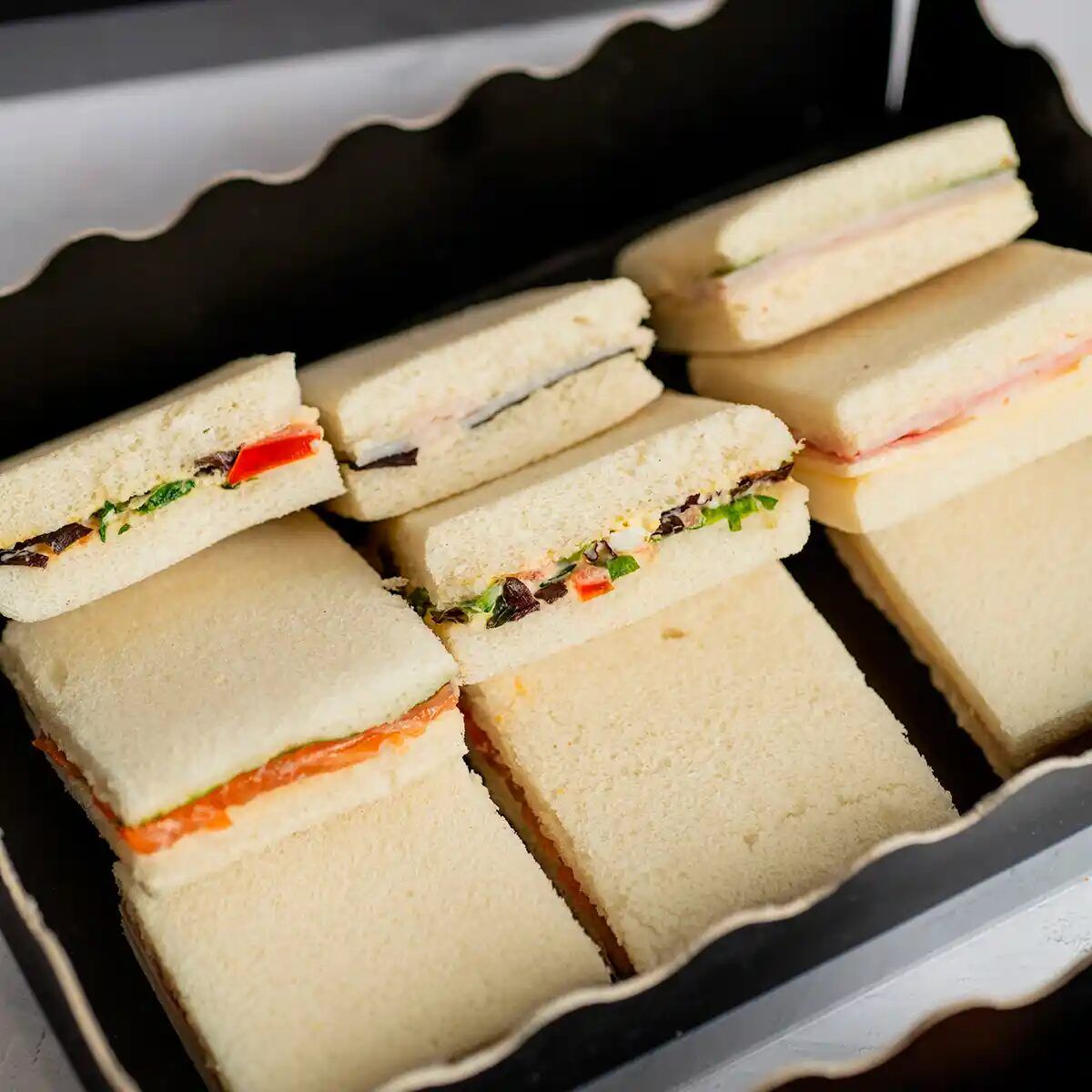
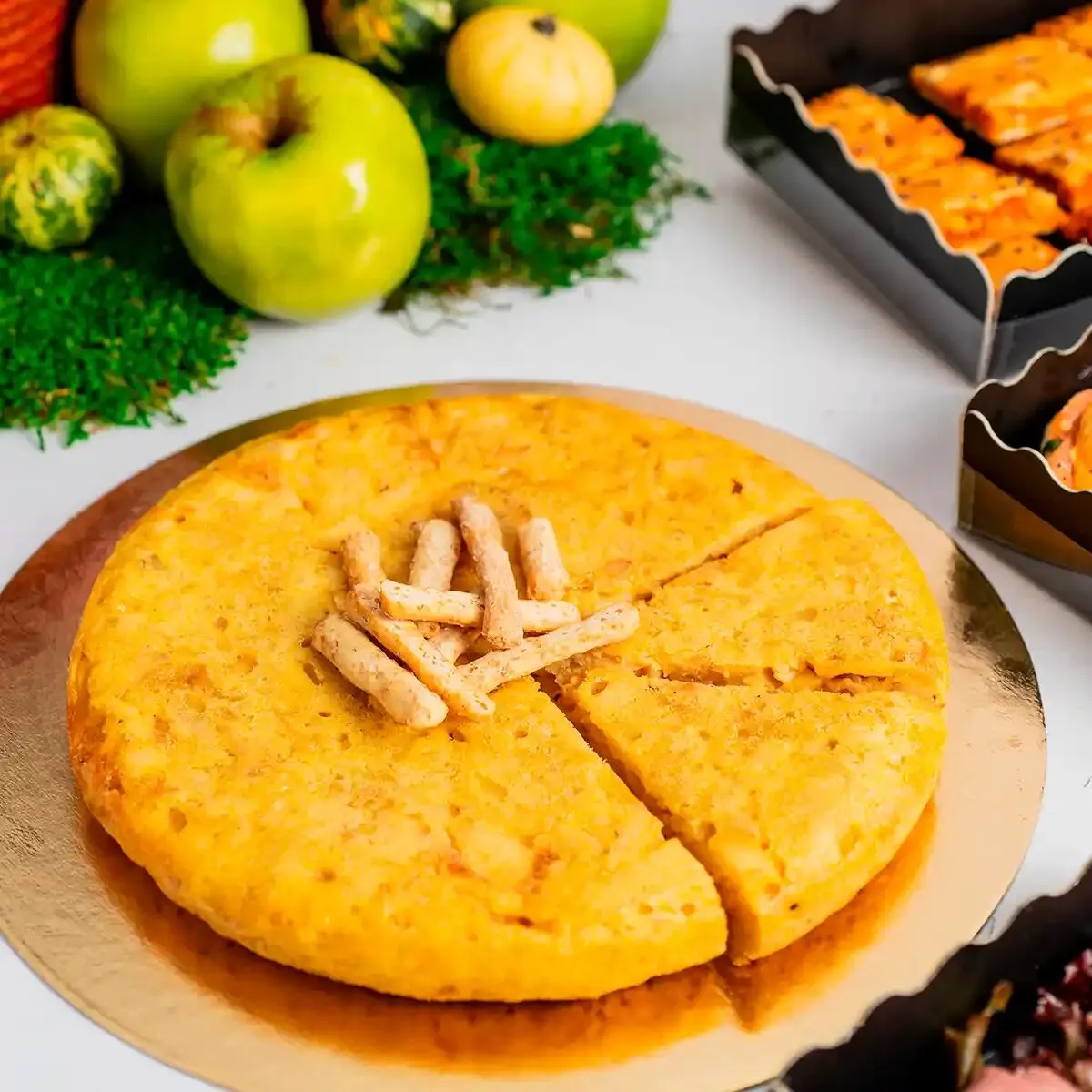
The best choices are foods that do not stain or make noise: mini sandwiches, small baguette rolls, filled croissants, portioned Spanish omelette, skewers and cut fruit. It is better to avoid loose sauces, crunchy fried food, strongly scented food and packaging that rustles when opened.

Leave someone in charge of receiving the supplier and ask them to clear the leftovers as soon as it ends. The rest is logistics: cups, napkins and bins within reach.
Steady energy and hydration: avoid the post-lunch slump
To avoid the slump after lunch, serve moderate portions with protein, vegetables and some complex carbohydrate, and leave the sweet things for the break. And keep water always in sight, because thirst is easily mistaken for tiredness and people drink little in closed rooms.
In practice: a light working lunch, with salad, a main course that is not too fatty and fruit for dessert, works better than a heavy menu. Keep the coffee for after lunch, and count on about 330 ml of water per person at each break, which is the coffee break reference.
Dietary needs and allergens: ask when you send the invitation
Ask about dietary needs and allergies when you send the invitation, not the day before. With that list, the supplier adapts the menu and labels each item. In mixed groups, always include a vegetarian option and make clear what each tray contains.
Take allergies seriously: the supplier must know which allergens to avoid and how to keep food separate to prevent cross-contamination. Our glossary has an entry on the 14 allergens that must be declared.
Frequently asked questions about what to serve at a business meeting
What do you serve at a one-hour business meeting?
For one hour, coffee, water and one or two small pieces, served before you start, welcome-coffee style, are enough. If it is first thing and people have not had breakfast, a light working breakfast with fruit and something savoury is plenty. You need neither a break nor lunch.
When is a coffee break better than a working lunch?
A coffee break suits breaks of 20 to 30 minutes between sessions. A working lunch is for when the day runs past midday and you want to eat without leaving the room. If the meeting lasts under three hours and does not go past midday, a coffee break is enough.
What food does not stain or make noise in a meeting?
Mini sandwiches, small baguette rolls, filled croissants, portioned Spanish omelette, skewers and cut fruit. They are eaten in one or two bites, with no cutlery and no loose sauces. It is best to avoid very crunchy fried food, noisy packaging and strongly scented food that would bother people in a closed room.
What food can you serve without heating at a meeting?
Almost everything that works in a meeting room is cold or eaten at room temperature: mini sandwiches, small baguette rolls, filled croissants, portioned Spanish omelette, salads in cups, hummus with crudités, cut fruit and sponge cake. That way you need no kitchenette or oven, and anything that needs to stay cold keeps in a fridge until it is served.
Next step
With the duration, time and number of attendees you can now choose a format. If you want an idea of quantities, start with the guide to prices and quantities. And if you would rather we take care of it, tell us the date and number of attendees and we will prepare the proposal.
Related service: Corporate catering
More in Blog.